


McKenzie - Holiday Farm fire - Labor Day 2020
Weyerhauser corporation's tree farms amplified firestorm
clearcuts cause climate change - fragmentation dries out forests
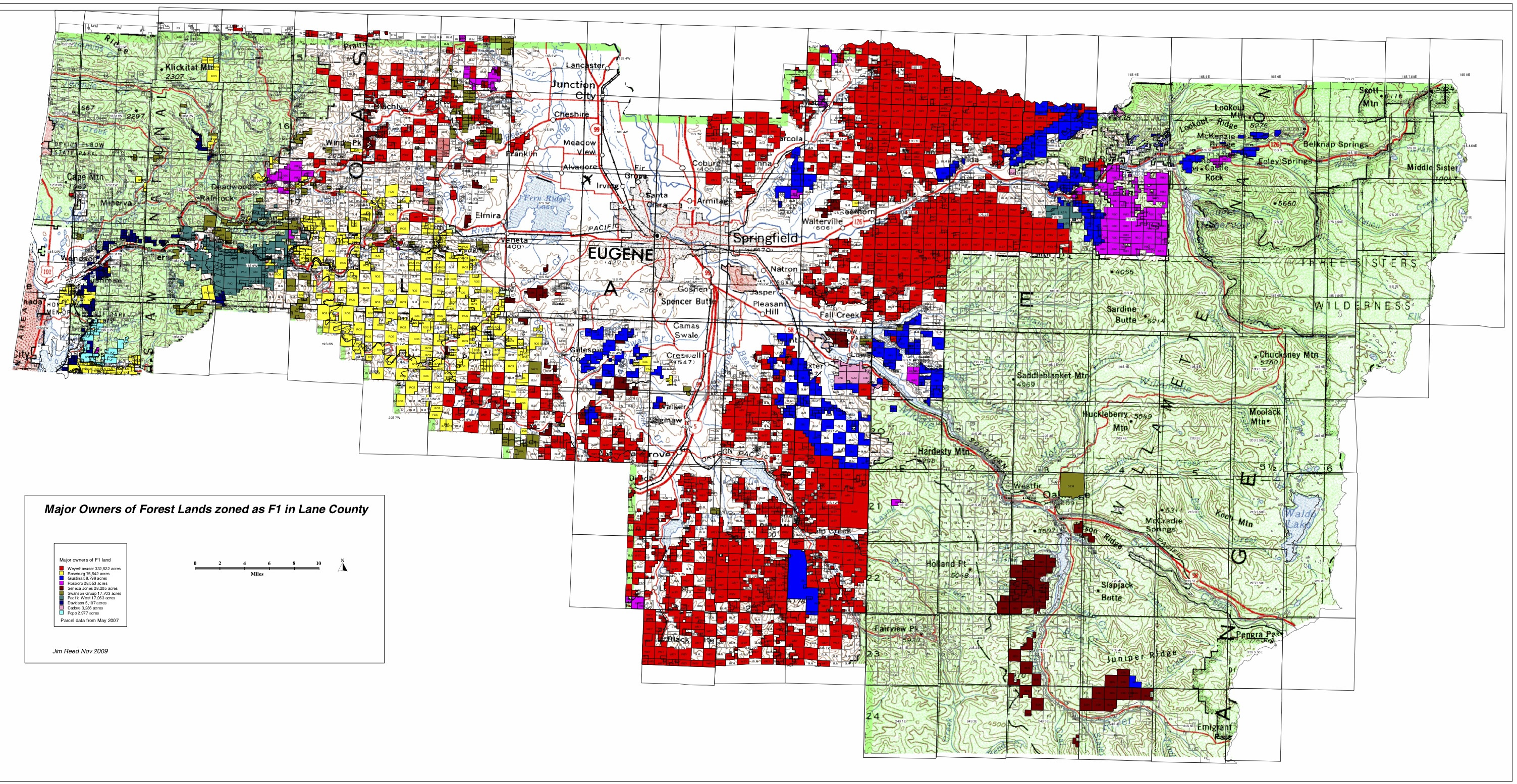
Most of the forest the Holiday Farm fire burned through in the McKenzie river watershed has been corporate industrial forestland mostly covered with monoculture tree plantations.
RED - Weyerhauser
Magenta - Rosboro
Blue - Giustina
light green on right of map - Willamette National Forest, US Department of Agriculture
some white squares in the middle - Bureau of Land Management, US Department of Interior
each small square is a square mile
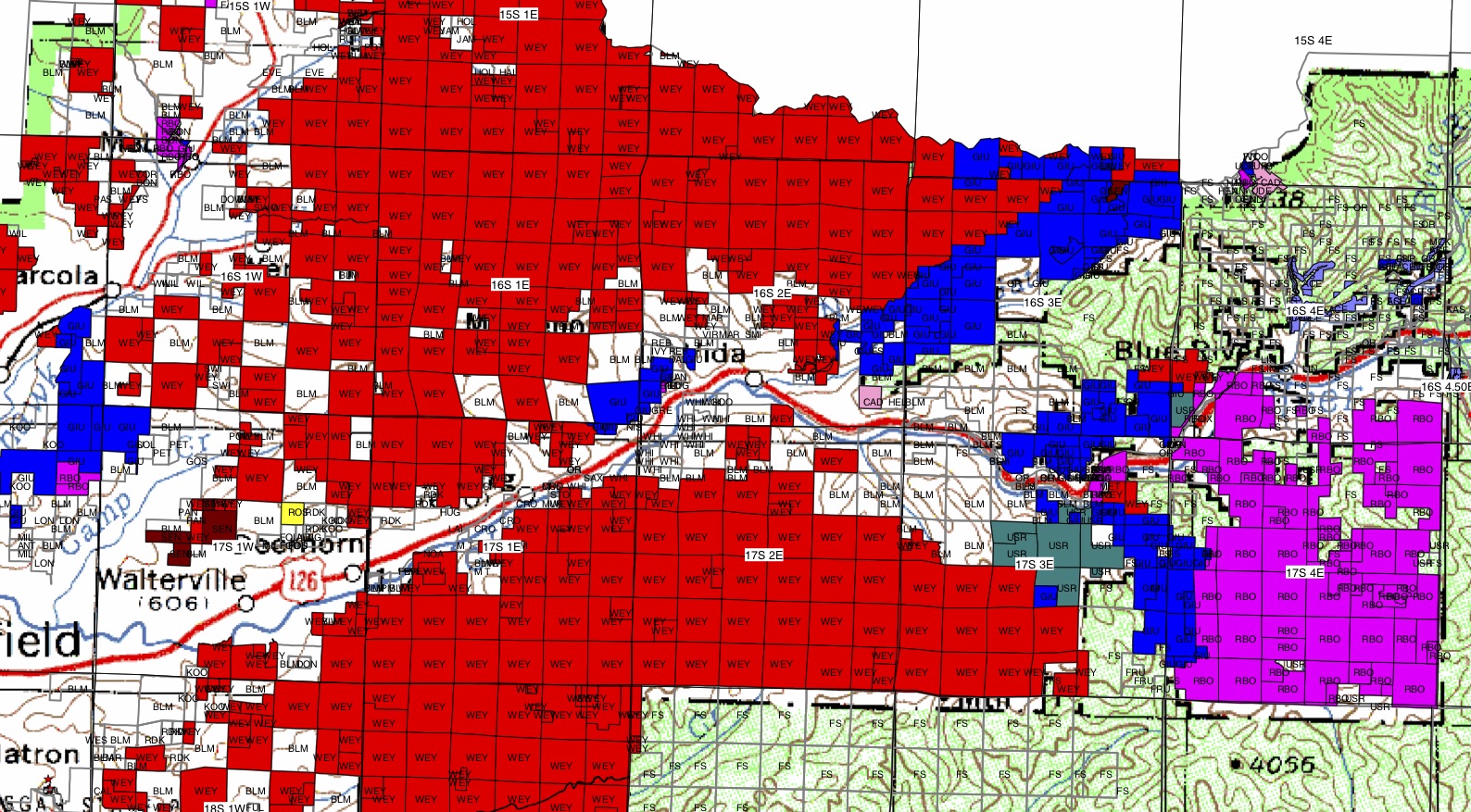
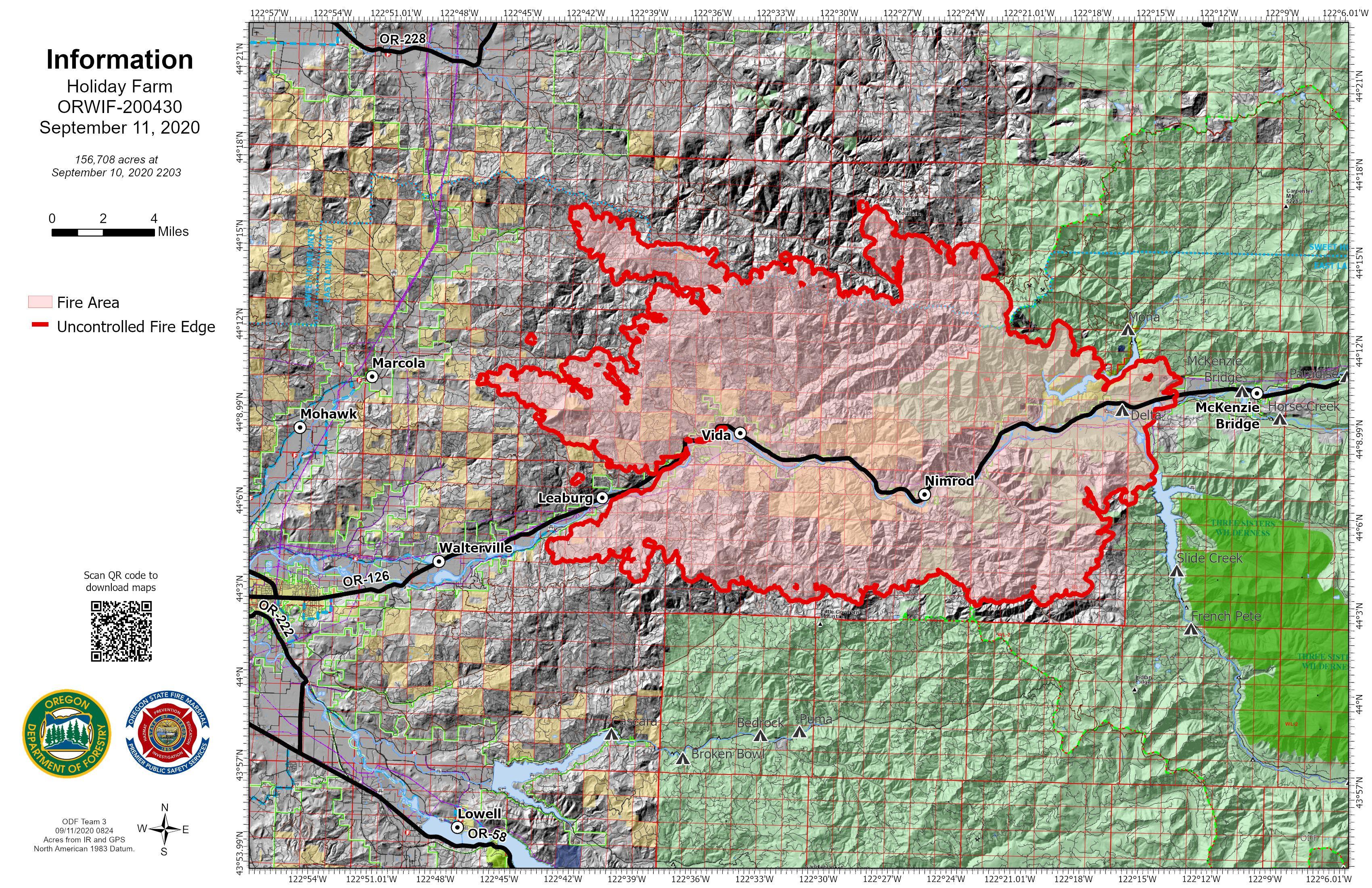
Delta Grove, a spectacular remnant of low elevation forest, is at the far right of the McKenzie forest ownership closeup, near the intersection of Highway 126 and Cougar Reservoir / Aufderheide Drive. The official fire perimeter map, copied below, shows Delta Grove, part of Delta Campground, was burned. Old growth fires can be more of a patchwork than a stand replacing crown fire, and Delta is an island between the main branch and the south fork of the river. I visited Delta Grove on August 15, 2020, the hottest day of the summer (102 degrees F, 39 C), and it was still relatively damp under the giant trees. Big trees long ago lost their lowest branches, making it difficult for all but the hottest fires to find their way into the canopy. Mature Douglas Firs bark is thick and fire resistant.
Holiday Farm fire range of severity
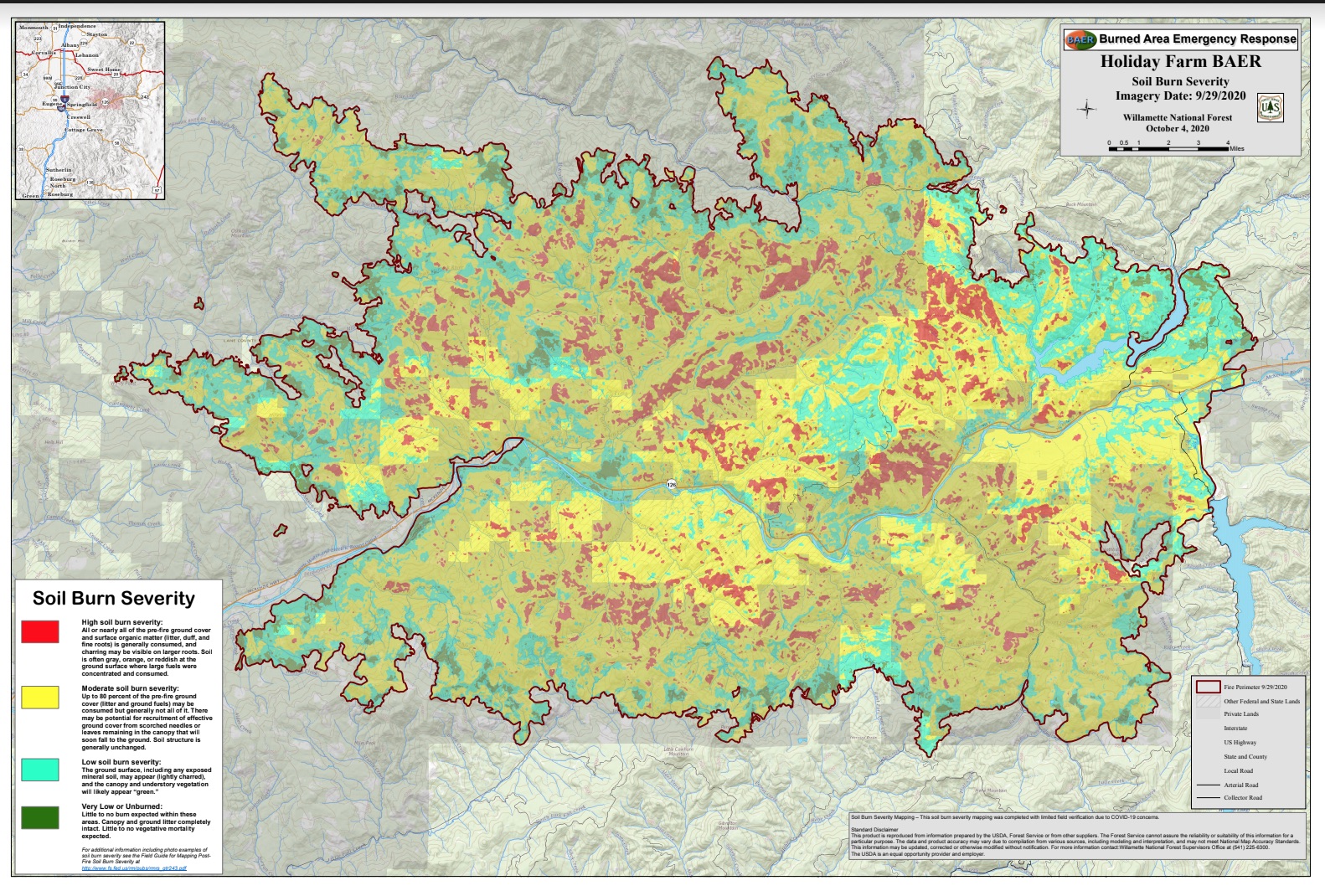
Holiday Farm fire perimeter
Lane County Corporate ownership
map from Forestland Dwellers
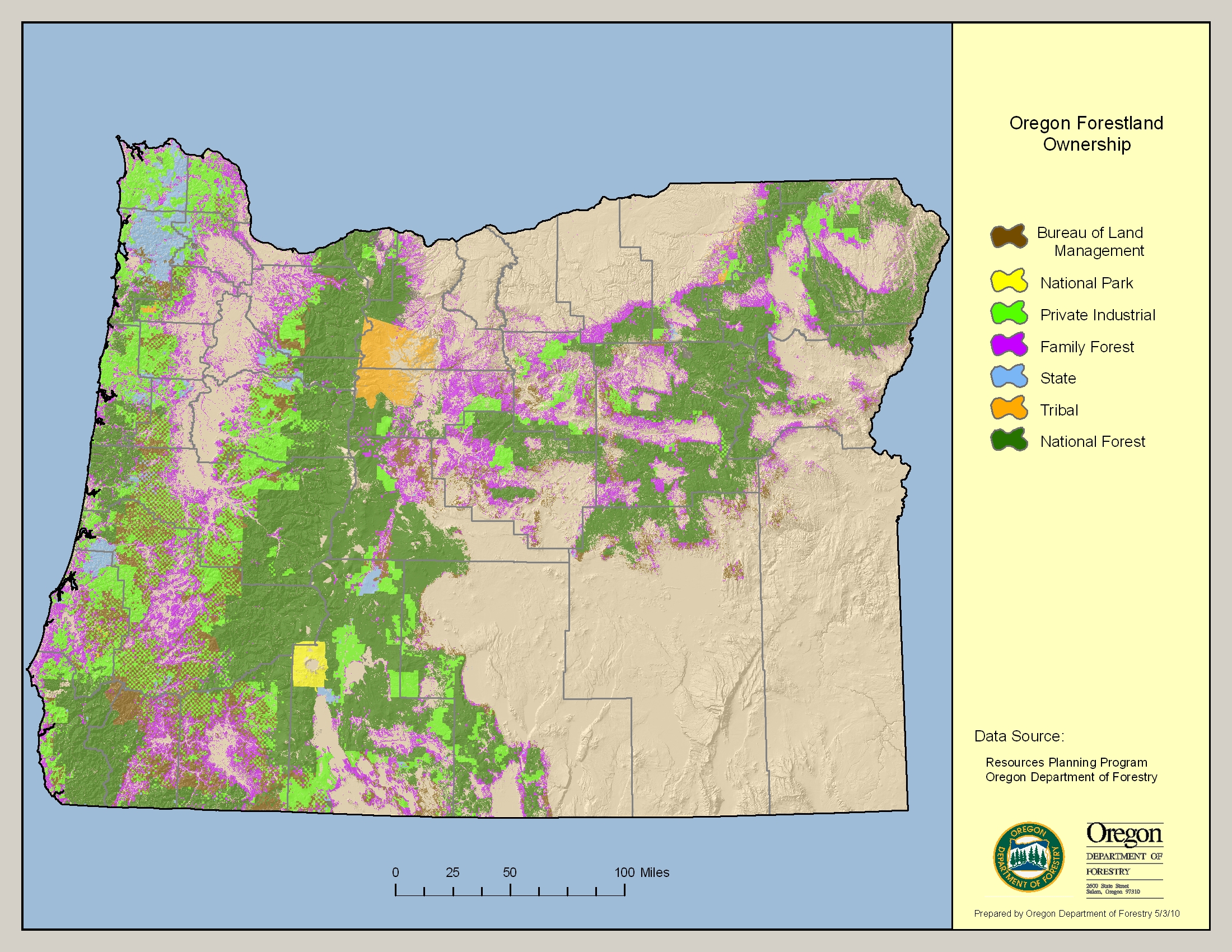
Oregon Department of Forestry map showing corporate industrial clearcutters control most of the foothill forests of the Cascades. Not coincidentally, these areas have greater growth rates than the higher elevation, snowier National Forests.
Forest Solutions
- selective forestry that maintains canopies provides more board feet in the long run
- cooperatives instead of limited liability corporations to manage and restore tree farms back to forests
- demand reduction for wood and paper products
- shifting away from endless growth models toward steady state economics for a round, finite planet
- beyond "Wilderness" - convert National Forests into National Parks and create a new Civilian Conservation Corps
- mycoremediation: don't burn slash piles, use mushrooms to convert brush piles to soil
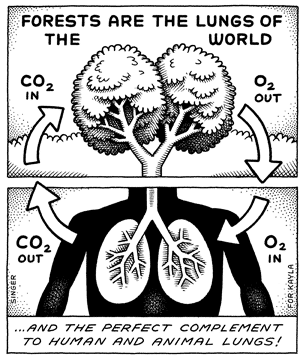
If we really wanted to mitigate climate change, we would let tree plantations grow back into old forests.
If we were concerned about a forest economy, raw log exports would be banned and we would think about value added products from milled logs (and non-timber products from forests) instead of treating the landscape as a raw material for a globalized market. (Oregon’s annual sales of furniture is less than the cost of a highway interchange.) Selective forestry can make more board feet in the long run than short rotation clearcuts, but this conflicts with corporate requirements for maximum short term profit.
We could recreate the New Deal era Civilian Conservation Corps to restore clearcuts and tree farms into forests.
We could prohibit timber companies from spraying poison from helicopters that drifts downwind for miles and accumulates up the food chain, which contaminates all species.
If we wanted to protect biodiversity, carbon storage, air and water quality, scenic vistas, recreation and the hydrologic cycle, we would convert Oregon’s National Forests, BLM Oregon and California lands, and State Forests into protected parks for future generations of all species. Cascadia National Park!
Because without the rain forests, we're going to have deserts. The food supply will dwindle. As a matter of fact, there's even the possibility that we're going to lose all kinds of valuable substances we know nothing about. Those rain forests have an incredible number of species of plants and animals that we know very little about. Some of them may produce chemicals of great pharmacological and medical importance. If properly cultivated, some of the plants might be new food sources. In addition to that, nothing produces the oxygen of the atmosphere with the same intensity that a forest does. Anything that substitutes for it will be producing less oxygen. We're going to be destroying our atmosphere, too.
--
Isaac Asimov
John Muir
"Why then," it will be asked, "are the Big Tree groves always found on well-watered spots?" Simply because Big Trees give rise to streams. It is a mistake to suppose that the water is the cause of the groves being there. On the contrary, the groves are the cause of the water being there. The roots of this immense tree fill the ground, forming a sponge which hoards the bounty of the clouds and sends it forth in clear perennial streams instead of allowing it to rush headlong in short-lived destructive floods. Evaporation is also checked, and the air kept still in the shady Sequoia depths, while thirsty robber winds are shut out.
-- John Muir, "Sierra Big Trees," 1901
In the forest between the Middle and East forks of the Kaweah, I met a great fire, and as fire is the master scourge and controller of the distribution of trees, I stopped to watch it and learn what I could of its works and ways with the giants. It came racing up the steep chaparral-covered slopes of the East Fork canon with passionate enthusiasm in a broad cataract of flames, now bending down low to feed on the green bushes, devouring acres of them at a breath, now towering high in the air as if looking abroad to choose a way, then stooping to feed again, the luricd flapping surges and the smoke and terrible rushing and roaring hiding all that is gentle and orderly in the work. But as soon as the deep forest was reached the ungovernable flood became calm like a torrent entering a lake, creeping and spreading beneath the trees where the ground was level or sloped gently, slowly nibbling the cake of compressed needles and scales with flames an inch high, rising here and there to a foot or two on dry twigs and clumps of small bushes and brome grass. Only at considerable intervals were fierce bonfires lighted, where heavy branches broken off by snow had accumulated, or around some venerable giant whose head had been stricken off by lightning.
I tethered Brownie [his mule] on the edge of a little meadow beside a stream a good safe way off, and then cautiously chose a camp for myself in a big stout hollow trunk not likely to be crushed by the fall of burning trees, and made a bed of ferns and boughs in it. The night, however, and the strange wild fireworks were too beautiful and exciting to allow much sleep. There was no danger of being chased and hemmed in, for in the main forest belt of the Sierra, even when swift winds are blowing, fire seldom or never sweep over the trees in broad all-embracing sheets as they do in the dense Rocky Mountain woods and in those of the Cascade Mountains of Oregon and washington. Here they creep from tree to tree with tranquil deliberation, allowing close observation, though caution is required in venturing around the burning giants to avoid falling limbs and knots and fragments from dead shattered tops. Though the day was best for study, I sauntered about night after night, learning what I could and admiring the wonderful show vividly displayed in the lonely darkness, the ground-fire advancing in long crooked lines gently grazing and smoking on the close-pressed leaves, springing up in thousands of little jets of pure flame on dry tassels and twigs, and tall spires and flat sheets with jagged flapping edges dancing here and there on grass tufts and bushes, big bonfires blazing in perfect storms of energy where heavy branches mixed with small ones lay smashed together in hundred cord piles, big red arches between spreading root-swells and trees growing close together, huge fire-mantled trunks on the hill slopes glowing like bars of hot iron, violet-colored fire running up the tall trees, tracing the furrows of the bark in quick quivering rills, and lighting magnificent torches on dry shattered tops, and ever and anon, with a tremendous roar and burst of light, young trees clad in low-descending feathery branches vanishing in one flame two or three hundred feet high.
-- John Muir, Sierra Big Trees, pp. 55-57
Any fool can destroy trees. They cannot run away; and if they could, they would still be destroyed, chased and hunted down as long as fun or a dollar could be got out of their bark hides, branching horns, or magnificent bole backbones. Few that fell trees plant them; nor would planting avail much towards getting back anything like the noble primeval forests. During a man's life only saplings can be grown, in place of old trees -- tens of centuries old -- that have been destroyed. It took more than three thousand years to make some of the trees in these Western woods, -- trees that are still standing in perfect strength and beauty, waving and singing in the mighty forests of the Sierra. Through all the wonderful, eventful centuries since Christ's time -- and long before that -- God has cared for these trees, saved them from drought, disease, avalanches, and a thousand straining, leveling tempests and floods, but he cannot save them from fools, -- only Uncle Sam can do that.
-- John Muir
What is the purpose of the giant sequoia tree? The purpose of the giant sequoia tree is to provide shade for the tiny titmouse.
-- Edward Abbey
Thomas Jefferson’s Remarks on the Destruction of Forests
A friend of Thomas Jefferson wrote, in describing the new Federal City:
Indeed the whole plain was diversified with groves ... of forest trees which gave it the appearance of a fine park. Such as grew on the public grounds ought to have been preserved ... the poorer inhabitants cut down these noble and beautiful trees for fuel. In one single night seventy tulip-poplars were girdled, by which process life is destroyed, and afterwards cut up at their leisure ... Nothing affected Mr. Jefferson like this wanton destruction of the fine trees scattered over the city-grounds. I remember ... his exclaiming "I wish I was a despot that I might save the noble, the beautiful trees that are daily falling sacrifice to the cupidity of their owners, or the necessity of the poor." "And have you not authority to save those on the public grounds?" asked one of the company. "No!" answered Mr. J., "Only an armed guard could save them. The unnecessary felling of a tree, perhaps the growth of centuries, seems to me a crime little short of murder, it pains me to an unspeakable degree."
-- quoted in Maryland Native Plant Society, Native News, Vol. 3, number 3 (December 1995), p. 6
"To Wake Up One Day Different"
dialogue with rainforest defender John Seed and Ram Dass, from 1991, best introduction I've read to deep ecology, one of the few that integrates a deep ecology perspective with the inescapable fact that all future generations are stuck being "nuclear babysitters" to keep our radioactive excrement out of the biosphere as much as possible
www.oilempire.us/deep-ecology.html
From the "Guide to the Flora of Washington [DC] and Vicinity,"
Lester F. Ward, A.M., A Bulletin of the US National Museum, 1881
"In many respects the botanist looks at the world from a point of view precisely the reverse of that of other people. Rich fields of corn are to him waste lands; cities are his abhorrence, and great open areas under high cultivation he calls 'poor country'; while on the other hand the impenetrable forest delights his gaze, the rocky cliff charms him, thin-soiled barrens, boggy fens, and unreclaimable swamps and morasses are for him the finest land in a State. He takes no delight in the 'march of civilization,' the ax and the plow are to him symbols of barbarism, and the reclaiming of waste lands and opening up of his favorite haunts to civilization he instinctively denounces as acts of vandalism."
When I would recreate myself, I seek the darkest wood, the thickest and most interminable, and to the citizen, most dismal swamp. I enter the swamp as a sacred place - a "sanctum sanctorum." There is the strength, the marrow of nature.
-- Henry David Thoreau